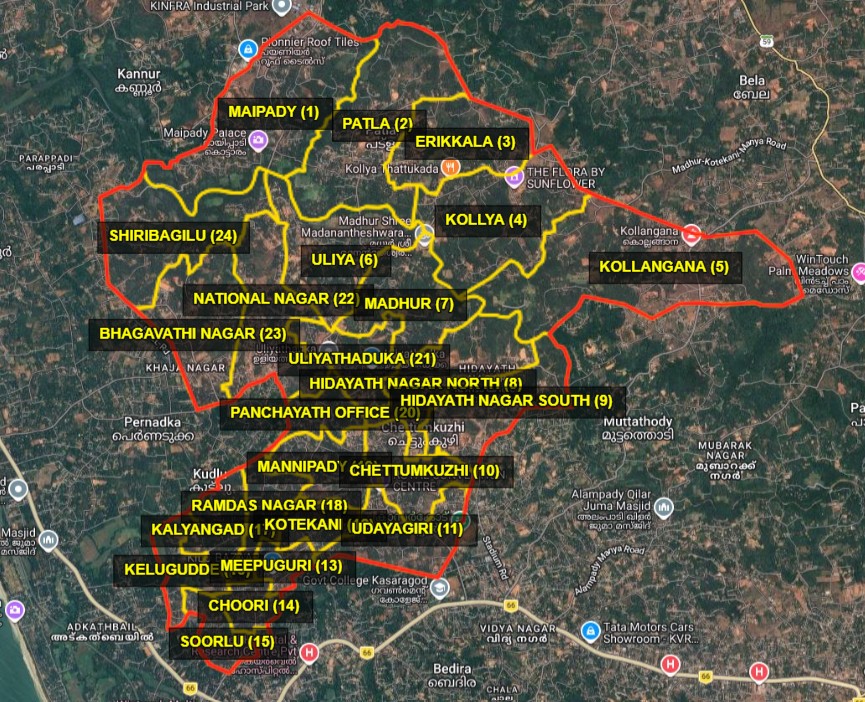
Geography
Topography
Madhur Panchayat lies immediately to the north of Kasaragod Municipality and covers an area of 26.04 square kilometers. This region slopes from east to west and is situated between 31° and 34° north latitude and around 76° east longitude. The Panchayat consists of:
- 10% laterite-clay soil areas
- 35% laterite regions
- 15% clay soil regions
- 5% grasslands
- 5% marshy lands
- 30% red soil regions
Laterite-Clay Soil Areas
Laterite-clay soil is found in the regions of Parakkila, Kannigudde, Pannippara, Shiribagilu, Bera, and Erikkale. This type of soil is generally unsuitable for agriculture.
Laterite Regions
Laterite-mixed soils are seen in Kolliya, Aranthodu, Patla, Shiribagilu, Bedraduka, and Uliyathadukka. Rocky areas unsuitable for cultivation are also found here. Coconut trees, cashew trees, and wild vegetation are common in these areas. Due to water scarcity, these regions are not suitable for most agricultural activities.
The major hills in this region include:
- Madhur Kottakani
- Kolankana
- Korathippara
- Shippara
- Chenakkode Battery
- Mayippadi Kavugudde
- Hills in the Patla region
- Kajekunnu
- Bedraduka Kinnigoli
- Hills in the Neerala–Periyadukka region
- Hills in the Pulikkur region
- Kudludevaregudde
- Manjathadukka Kotte
- Mannippadi Gude
- Alamkode Gude
- Pannamkoli
- Kure Kunnu
- Kelukunnu
- Kettarikunnu
Clay Soil Regions
Clay soil is found in Madhur, Mayippadi, Patla, Chenakkode, Shiribagilu, Kudlu, and Aranthodu regions. Paddy cultivation and vegetable farming are mainly carried out here.
Grasslands
Grasslands covered mainly with grasses are seen in the Uliyathadukka region. These areas serve as grazing lands for cattle.
Marshy Lands
Marshy lands are found in Shiribagilu, Mayippadi, Madhur, and Patla regions. Since water remains stagnant in these areas, first-season paddy cultivation is difficult.
Red Soil Regions
This type of soil is found in most parts of the Panchayat. In areas with sufficient water availability, arecanut, coconut, and betel leaf cultivation are practiced, while cashew cultivation is common in water-scarce areas.
Water Resources
This Panchayat is one of the regions in Kerala that receives heavy rainfall. However, due to the absence of systems to conserve rainwater and the lack of public awareness regarding watershed management, water scarcity is experienced from December onwards. As a result, agricultural crops suffer from drought conditions.
The major water resource, the Madhuvahini River, flows for about 11.5 kilometers through this Panchayat. The Panchayat also has:
- 29 kilometers of streams and canals
- 17 ponds
In addition, many farmers maintain private ponds for irrigation purposes. By March, as the water level in the Madhuvahini River declines, nearby ponds also experience reduced water availability, leading to severe water shortages.
Biodiversity
In earlier times, this region was rich in dense vegetation and forests where animals such as tigers, deer, wild boars, and black monkeys roamed freely. Rare species of birds were also found here. Even today, peacocks, Hanuman birds, and black monkeys are occasionally seen, though they are now facing the threat of extinction.
As part of tree worship, deity worship, and serpent worship traditions, numerous sacred groves once existed in this area. However, due to human encroachment, many large trees have disappeared and the sacred groves have been destroyed. Even so, more than a hundred small groves still survive in different parts of the Panchayat.
The following are some of the plant species that were once abundant in this region and are now rarely found:
- Cinnamon
- Punnakka tree
- Bandha tree
- Karingali
- Karimaram
- Wild palm
- Sandalwood tree
- Eetti tree
- Irumullu
- Punnarpuli
- Venga tree
- Bannappoo mango tree
- Jackfruit tree
- Teak tree